
McHenry Projected Release Dates
McHenry County uses different date labels for different custody systems. The Sheriff’s live PDF can show a Sentenced Release Date for a local jail sentence. IDOC records can show a Projected Parole Date and a Projected Discharge Date. These fields answer different questions. The parole date generally anticipates movement from an IDOC institution to Mandatory Supervised Release, while the discharge date anticipates the end of the full state sentence and supervision.
Pretrial detention works differently. A person held while a case is pending does not have a sentence-based release date. Release may depend on a court order, conditions, another case, or a hold. The McHenry County Circuit Clerk docket can show the judicial action, while the Sheriff report shows the later custody event. A future court date is not a release date, and a charge row marked released at court does not override an overall status that still says currently confined.
State prison release can also begin supervision rather than end the whole sentence. An IDOC record marked PAROLE with a past Parole Date and a future Projected Discharge Date shows that institutional custody ended while state supervision continues. Final discharge is a separate event that can involve the Illinois Prisoner Review Board.
Find McHenry Release Dates
Start with the sentencing source, not a rough percentage applied to the headline term. The judgment and mittimus, which is the court’s commitment order, identify the offenses and custody authority. Jail credit, offense dates, concurrent or consecutive terms, and later orders all affect the agency calculation.
- Identify whether the person is pretrial, serving a McHenry County jail sentence, or serving an IDOC sentence.
- Obtain the judgment and sentence from the McHenry County Circuit Clerk case portal or official court file.
- Record each offense subsection, offense date, term, and whether terms run together or one after another.
- Verify credited time already spent in custody and any separate hold or detainer.
- For county custody, read the Sheriff PDF’s exact Sentenced Release Date label.
- For state custody, open the IDOC Individual in Custody Search and record the exact projected field.
- Recheck close to the date, then confirm the actual event through custody status and the official release record.
The official IDOC search screen below is linked from the Illinois Department of Corrections offender search. Search by IDOC number when known, or use name and verify the result with birth date and sentencing facts.
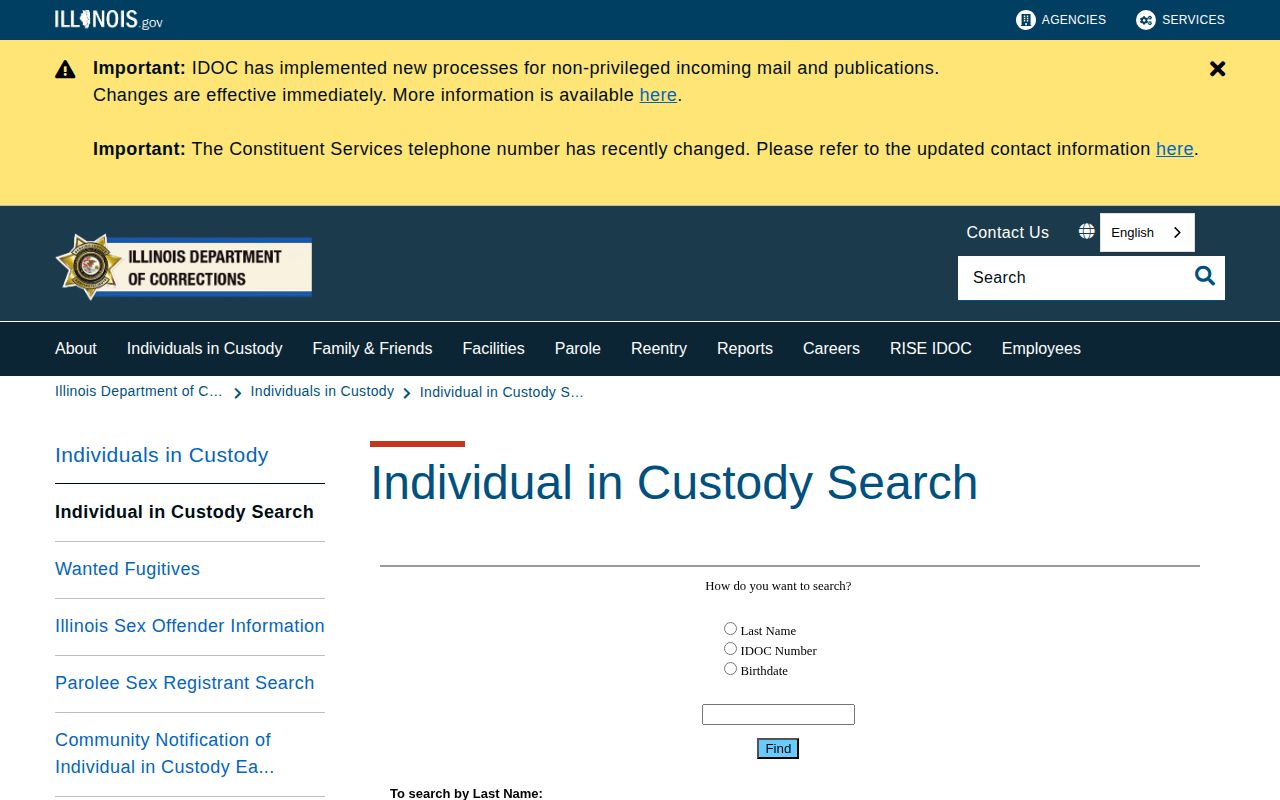
The search entry is only the start. The selected IDOC detail must be read for status, location, sentence data, and the exact projected date label displayed for that person.
The McHenry County VINELink inmate search can add a status-change alert, but VINE does not replace the sentencing record or IDOC calculation.
McHenry Release Labels Compared
Using the agency’s label prevents one date from being mistaken for another. Historical fields also vary by sentence type and record age, so not every IDOC result will show the same set. Quote the label exactly and note when the record was checked.
| Field or event | Meaning | Best source |
|---|---|---|
| Sentenced Release Date | Local county sentence calculation shown before release; not an observed exit. | McHenry Sheriff PDF and court order |
| Projected Parole Date | Anticipated exit from an IDOC institution to parole or MSR when applicable. | IDOC detail |
| Projected Discharge Date | Anticipated end of the state sentence and supervision. | IDOC detail and PRB records |
| Mandatory release date | A separate calculation discussed in IDOC sentence policy, affected by specified lost time. | IDOC master record |
| Recently Released On | Observed McHenry County release date, time, and reason after the local event. | Sheriff PDF |
| Parole Date with PAROLE status | Past state prison exit while state supervision continues. | IDOC status and date fields |
| Final discharge | End of parole or MSR supervision, distinct from leaving prison. | IDOC and PRB |
“Sent to Prison” in a McHenry charge row is a transfer to IDOC, not release to the community. The county report documents the handoff. IDOC then controls the state sentence calculation. Conversely, a person serving a local sentence remains on the county path unless a transfer or another legal authority changes custody.
- Projected
- An estimate based on the present sentence calculation and known facts.
- Mandatory Supervised Release
- Community supervision that follows many determinate Illinois prison sentences.
- Discharge
- The end of state supervision, which can occur after physical prison release.
- Detainer
- A request or legal hold that can cause another agency to take custody.
- Jail credit
- Eligible time already spent in custody that is applied to the sentence calculation.
Illinois Sentence Credit Rules
Illinois does not have one universal “serve 85 percent” rule. 730 ILCS 5/3-6-3 creates several sentence-credit regimes based on the offense, offense date, sentence, and statutory exceptions. Under the general eligible rule, one day of statutory credit may be earned for each day imprisoned or recommitted. This is often called day-for-day or 50 percent, but eligibility still must be verified.
Natural-life sentences receive no sentence credit. Enumerated serious-offense categories limit credit to 4.5 days per month, which produces the familiar approximate 85 percent description. Certain listed drug categories use a 7.5-day-per-month ceiling, often described as about 75 percent. Some offenses prohibit credit and effectively require service of the full imprisonment portion. None of these shorthand percentages should be used until the precise offense subsection and operative date are known.
| Credit framework | What must be checked |
|---|---|
| General eligible credit | Whether the offense and sentence qualify for one credit day per day served. |
| 4.5 days per month maximum | The exact serious-offense category and applicable offense date. |
| 7.5 days per month maximum | The listed drug category, offense date, and statutory floor. |
| No credit | Whether the sentence is natural life or another statutory no-credit category. |
| Program or educational credit | Eligibility, successful completion, exclusions, written awards, and minimum-service rules. |
Additional credit is not automatic. The statute and IDOC rules address successful programming, compliance, service, and educational achievements, subject to exclusions and a Director’s written eligibility decision. The research identifies specified awards such as 90 days for qualifying high-school-equivalency completion and 120 days for a qualifying associate degree, but statutory limits and floors still apply. At least 60 days of custody, including eligible county jail time, is ordinarily required for specified added awards.
Note: A percentage estimate without the judgment, offense date, and IDOC calculation is not a reliable McHenry County projected release date.
IDOC Release Calculation Records
IDOC Administrative Directive 01.07.400 states that determinate sentences are calculated to produce projected and mandatory release dates. The projected date can reflect statutory credit that may be awarded, revoked, or restored. The mandatory date changes for loss of time caused by absence from Department supervision, such as escape, an MSR violation, or release on bond. Consecutive terms are aggregated, while custody date and jail credit affect the starting calculation.
The administrative record is broader than one public field. Related directives cover earned program credit, single and concurrent determinate terms, jail credit, revocation of good-conduct credit, earned discretionary credit, master-file review before release, and discharge records. A focused IDOC request is the right path when the public result conflicts with the court order or a certified calculation is needed.
Before release, master-file review can identify another sentence, warrant, hold, or calculation issue. When an earned-credit award will move release earlier, the statute requires reasonable notice of at least 14 days to the prosecuting State’s Attorney and, when applicable, the State’s Attorney in the release county. That notice is not a public release feed. It is one administrative event that may precede a changed projected date.
Why McHenry Release Dates Change
A projection is a snapshot of the calculation at the time it is displayed. New facts can move it in either direction. Some changes arise from the sentence itself, while others arise from conduct, a court order, or a second custodian.
| Change | Possible effect |
|---|---|
| Jail credit correction | Moves the calculation when prior custody time was omitted or changed. |
| Concurrent or consecutive structure | Changes whether terms overlap or are added together. |
| New sentence or modified order | Requires the agency to recalculate from the controlling judgment. |
| Credit award, loss, or restoration | Can advance or delay the projected institutional release date within the rules. |
| Escape, absence, or MSR violation | Can add lost time, interrupt supervision, or return the case for calculation. |
| Detainer or another-agency hold | Can cause transfer after one custodian’s release date rather than community return. |
| Parole or PRB action | Can set conditions, maintain release, impose a sanction, revoke release, or enter final discharge. |
For McHenry County jail time, use the Sheriff’s local sentenced field and the Circuit Clerk order. For a state prison term, use IDOC. Credit for pre-sentence confinement can cross the two systems, but the sentencing order and agency computation control. The later release event settles what happened, not the projection alone.
PRB calendars and hearing lists should not be mistaken for release decisions. Ordinary modern determinate release generally follows sentence calculation to MSR. Traditional discretionary parole mainly concerns older indeterminate sentences and limited statutory categories. When PRB is involved, use the actual result rather than an agenda.
The McHenry County released-inmates record path explains how to confirm the later county, state, federal, or immigration event once the projected date arrives.
Public Record Search
Sponsored Results